Vidhi Gupta
08-Aug-2026

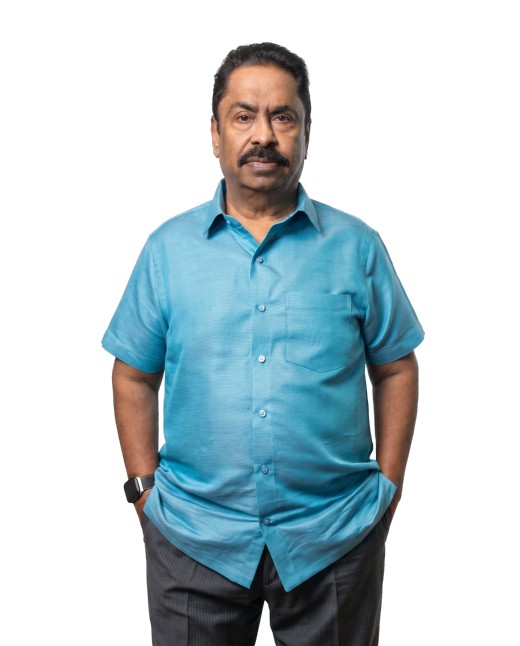
C. SIVASANKARAN, businessman and serial entrepreneur, recounts his lifelong experiences to expound on prevention, precision, and the science of not becoming a patient.
C. Sivasankaran has done one thing unusually well: questioning the price of things everyone else has accepted as inevitable. From selling personal computers at a fraction of the prevailing cost to helping build India’s telecom revolution, the serial entrepreneur has spent four decades building a career on measurement, efficiency, and the conviction that systems can work better. On reaching 70, he is applying that same instinct to a more personal—and consequential—system: the human body.
At AIWO, longevity is not about simply adding years to life but shortening the period of ill health and preserving strength, independence, purpose, and connection for as long as possible.
In this vein, Sivasankaran shares his philosophy on preventive health; the role of AI and continuous monitoring in the future of medicine; the biohacking interventions he believes are actually supported by evidence; and why he sees India as uniquely positioned to make longevity more accessible. His ambition is characteristically pragmatic. His objective is to take what works, compress its cost, and ultimately be judged not by how many patients a system treats, but by how many people never become patients in the first place.
What inspired your transition to a vision of health and longevity?
I started in business in 1985. I bought Sterling Computers and sold personal computers at thirty-three thousand rupees when the rest of the market was selling them at eighty thousand. That was the entire business. Everyone said it could not be done at that price. Then everyone did it at that price.
I spent the next thirty years doing versions of the same thing. Computers, then the internet, then telecom. Every one of those businesses ran on measurement. In telecom you know which tower is weak at three in the morning. You know it before the customer knows it. You fix it before anyone complains. That is the whole discipline, and it is not complicated.
One day it struck me that I had never applied that discipline to myself. I knew my balance sheet to the rupee. I did not know my ApoB. I could forecast a company three years out. I could not forecast my own body three months out — and neither could anyone else, because nobody had ever thought to ask the question.
What bothered me was not that I had been careless. I had done exactly what a responsible man is told to do. Annual check-up. Report says normal. Carry on. And then I learned that in medicine, normal usually means we have not found it yet. Those are two completely different sentences, and the distance between them is where most of a life is lost.
That was the moment. Not fear — recognition. I have spent my life looking for the one thing everybody accepts simply because it has always been that way. That instinct built every company I have owned. Here was the largest example of it I had ever seen, sitting inside the most important industry in the world.
A country can build the finest hospitals on earth and still be a sick country. We have proved it. So, the question I could not put down was a simple one, and it was really an engineer’s question, not a doctor’s. If I could measure a network, why could I not measure a life?
What gap in traditional healthcare were you trying to address when conceptualising AIWO?
Healthcare today is not a health industry. It is a repair industry — and a brilliant one. If I have a heart attack tonight, take me to a hospital, not to a wellness coach. I will defend acute medicine against anybody.
But look honestly at who gets paid, and for what. A hospital earns when you are admitted. A pharmaceutical company earns when you take something every day for twenty years. A laboratory earns per test, not per outcome. Nowhere in that chain does anybody earn from the one thing you actually want, which is never to arrive.
The second problem is fragmentation. A man of fifty-five in Chennai will see a cardiologist, an endocrinologist and an orthopaedic surgeon in the same year. All three are excellent. All three see one slice. Nobody notices that the tiredness, the rising sugar and the bad knee are one story being told in three different rooms to three different people.
The third is the one that costs Indians the most — the tyranny of the reference range. Those ranges are built from population averages. If the population is metabolically sick, then normal is simply the average of a sick country. And ours is a sick country. The national ICMR-INDIAB survey, which examined more than one lakh Indians across all thirty-one states, put it in black and white: 101 million Indians living with diabetes, and 136 million more sitting in prediabetes. 315 million with hypertension.
Look at that middle number again. There are more Indians in prediabetes than there are Indians with diabetes. That is not a disease statistic. That is an alarm going off fifteen years early, in a room where nobody has been taught to listen for it.
So AIWO was built on three ideas, and they are not complicated ideas. Measure the markers that predict, not only the ones that confirm. Keep one file for the whole human being, not four files for four organs. And define success as a number that moved, not an appointment that was attended.
I am not trying to replace the hospital. I am trying to shorten the queue outside it.
What do you think people still misunderstand about living longer and healthier?
Four things. I will take them in the order of how much they cost.
First, the word itself. People hear longevity and picture somebody at a hundred — frail, on machines, kept alive by money. Nobody wants that. Nobody is selling that. What we actually want is the opposite: to shorten the bad part. Most people spend their final decade dependent on somebody else. The goal is not to stretch that decade. It is to shrink it.
Second, people believe longevity is something you buy. A supplement, a device, an injection. The evidence says otherwise, and the gap is not small. In a Cleveland Clinic study of over one lakh twenty thousand adults, the least fit carried roughly five times the death rate of the fittest — and the researchers found no ceiling at all. The benefit simply kept rising. They wrote plainly that poor fitness carried risk comparable to or greater than coronary artery disease, diabetes and smoking. No pill on the market has that number. Fitness does. It is free. That is precisely why nobody advertises it.
Third — and this one is for the men reading this in India — thin is not the same as safe. South Asians have heart attacks roughly ten years earlier than Europeans. About one in four of us carries elevated lipoprotein(a). We store fat in the wrong places at body weights that look perfectly acceptable on a chart. The forty-four-year-old vegetarian who does not smoke and drops dead on a Sunday morning is not an unlucky exception. He is a pattern, and our imported reference ranges were never built to catch him.
Fourth, people treat health as a project that begins at sixty. It does not begin at sixty. It is already running. Your sixty is being written today, in what you did this week.
And let me kill the idea that this is a rich man’s game. A review of 148 studies covering more than three lakh people found that those with strong social relationships had a fifty per cent better likelihood of survival — an effect the researchers placed alongside the classical risk factors. That is not an expensive protocol. That is Sunday lunch with your family.
What trends do you foresee in wellness, longevity, and functional medicine?
Five shifts. All of them have already begun; most people simply have not noticed yet.
From once a year to always on. The annual master health check is a photograph of a moving object. Continuous monitoring turns that photograph into a film. The value is not the gadget — it is feedback fast enough to learn from. Most Indians have never once seen what two idlis do to their blood sugar. The day they see it, behaviour changes without a single lecture.
From the average patient to the actual patient. Clinical guidelines are built on averages, and nobody alive is average. The next decade belongs to protocols built on your genome, your markers, your response — not on the mean of a trial cohort from another continent.
From treatment to prediction. This is where artificial intelligence genuinely earns its money. A doctor reads thirty markers on a page. A model holds thousands of trajectories across years and notices the pattern that arrives before the diagnosis does. It will not replace the physician. It will hand the physician a question he had no reason to ask.
From supplements to precision nutrition. Most of the supplement business is faith sold in a bottle. What replaces it is unglamorous and rigorous — find the specific deficiency in the specific person, correct it, then measure whether it is actually corrected.
And from the clinic to the home. Diagnostics are moving to the dining table. The clinic becomes the place you go for judgement, not for a blood draw.
Now let me say the unpopular part, because I would rather be trusted than exciting. This field has a hype problem worse than telecom ever had. Epigenetic age clocks are a fascinating research tool, not something you should reorganise your life around. Senolytics remain largely animal work. Rapamycin and metformin in healthy people are open questions, not settled ones. Anybody selling you certainty on these is selling you something.
The honest position is this. The frontier is thrilling, the fundamentals are proven, and ninety per cent of your effort belongs with the fundamentals.
What’s your wellness philosophy? Do you have a wellness routine?
My philosophy is one line. Measure, don’t guess. Then be relentlessly ordinary about the basics.
I have watched very intelligent men run a thousand-crore company on data and run their own body on opinion. They will tell you they feel fine. Feeling fine is not a diagnostic. Every one of those 136 million prediabetic Indians feels fine this morning. That is exactly what is wrong with feeling fine.
So my first rule is that I do not argue with my numbers. If a marker moves the wrong way, I change one thing and I re-measure in twelve weeks. One thing — not five, because then you learn nothing about which one worked. It is the same discipline as a quarterly review, applied to the only asset I cannot sell and cannot replace.
My second rule is that consistency beats intensity. I am not interested in a heroic month. I am interested in a decent decade. Nobody was ever ruined by a missed workout; people are ruined by the second missed workout becoming the third. I do not chase perfection. I chase not missing twice in a row.
Third — muscle is the currency of ageing. Most men over fifty are quietly losing strength every year and calling it getting older. The PURE study followed nearly one lakh forty thousand people across seventeen countries, including centres here in Chennai, and found that every five-kilogram decline in grip strength carried a sixteen per cent higher risk of death from any cause. Grip strength predicted death better than blood pressure did. Nobody mentions that at your health check. They take the blood pressure and send you home.
I will not bore you with my exact timings, because the timings are mine and they would not suit you. What matters is the structure, and the structure is simple enough to write on one hand. Move every day. Lift something heavy several times a week. Eat protein at every meal. Protect the sleep window like it is a board meeting. Test properly, on a schedule, whether or not you feel unwell.
The one I refuse to trade is sleep. For thirty years I treated sleep as the budget line you cut when the quarter is tight. It was the most expensive saving of my life.
If you could leave readers with one message about living a longer, healthier, and more meaningful life, what would it be?
Length without meaning is only duration. That is the whole message, and everything else I could say is a footnote to it.
I have spent my life around money, so let me tell you what I concluded after all of it. Money is a poor scoreboard. Real wealth is reputation, relationships, friendships, peace of mind. A man with a large balance sheet and nobody to telephone on a bad night is not a rich man. He is a well-funded one. I have met a great many of the second kind.
The same is true of years. Extend a life that has no purpose in it, and you have not given that person a gift. You have given him a longer wait.
So, build the health and build the reason at the same time. These are not two projects. A man with something to get up for sleeps better, moves more, drinks less, and stays close to people. Purpose is not a soft idea decorating the hard science. It sits upstream of it.
Then there is the arithmetic, and here I am on home ground. Everything in the body compounds exactly the way money compounds. A small deposit made early and never interrupted will beat an enormous one made late in a panic. Twenty minutes of walking every day from the age of thirty-five will outperform anything you can buy at sixty-five. Nobody enjoys hearing this, because it cannot be done in a weekend and it cannot be purchased.
And stop optimising for the finish line. Nobody will congratulate you on the number printed on your death certificate. Your children will measure you on something else entirely — whether you were present, whether you were sharp, and whether in your last ten years you could still do things with them rather than merely be visited by them.
Live so that the years are worth having. The number will take care of itself.
Which biohacking interventions do you believe have the strongest scientific evidence?
Let me answer this like a due diligence. In tiers — because the word biohacking has been stretched to cover both the proven and the imaginary, and the pricing runs in exactly the wrong direction.
Tier one is strong human evidence, and this is where your effort belongs. Cardiorespiratory fitness sits at the top and it is not close: over one lakh twenty thousand adults studied, roughly five times the mortality in the least fit versus the fittest, and no ceiling to the benefit. Then muscle — a sixteen per cent higher risk of death for every five kilograms of grip strength lost, across nearly one lakh forty thousand people in seventeen countries. Then sleep. Then blood pressure and ApoB, which are the best-evidenced targets in the whole of preventive cardiology. Then adequate protein. Then not smoking. And social connection, where a fifty per cent survival advantage was found across 148 separate studies.
Tier two is good evidence, real but smaller. Sauna: the Finnish Kuopio cohort followed men for a median of twenty years and found that four to seven sessions a week, compared with one, was associated with substantially lower cardiovascular and all-cause mortality. I will add in the same breath that this was an observational study, not a randomised one — association, not proof. Creatine monohydrate, one of the most studied compounds we have. Vitamin D where a deficiency is actually documented, which in this country is very common. Omega-3 where dietary intake is low.
Tier three is interesting, unproven, and where nearly all the marketing money sits. Rapamycin, senolytics, NAD precursors, plasma exchange, most peptides, most age-reversal claims. I follow this work with real interest. I would not build my own protocol on it, and I would be careful with anybody who sells it to you with confidence.
Let me also correct something I used to believe myself, because I would rather be caught changing my mind than caught being wrong. Time-restricted eating: when it was put to a proper randomised trial, the sixteen-eight group showed no significant weight advantage over normal meal timing, and there was a signal of lean mass being lost. The clock is not doing the work people think it is. If you use it, protect your protein and keep lifting.
The uncomfortable truth about this industry is that tier three is sold at premium prices, and tier one is free.
What role do you see India playing in shaping the global conversation around longevity and preventive healthcare?
India is two things at once. The world’s loudest warning, and its most useful laboratory.
The warning first, and I will not soften it. 101 million Indians with diabetes. 136 million in prediabetes. 315 million with hypertension. And the same national survey found that more than half of Indian adults are physically inactive, with fewer than one in ten doing any recreational exercise at all. Note where that evidence came from — much of that work was led out of Chennai. The data that indicts us was gathered in my own city, by our own people. We cannot claim we were not told.
That is exactly why India matters scientifically. Longevity research has been built almost entirely on European populations, and it does not transfer cleanly to us. We develop coronary disease a decade earlier. One in four of us carries elevated lipoprotein(a). Our fat goes to the wrong places at lower body weights. India is not a market for this science. India is a missing input to it.
But our real contribution will be economic, and this is the part I know something about. The West is building longevity as a luxury good — clinics priced so that they will never reach a population. India has spent forty years doing precisely the opposite. I sold a computer at thirty-three thousand rupees when the market insisted it cost eighty thousand. We did the same to telecom. We did it to generic medicines. We did it to payments.
That is the national skill, and we should name it honestly. It is not invention. It is compression — taking something that already works and driving the price down until it reaches a hundred million people. No other country has done that as many times, in as many industries, in a single generation.
So the choice in front of us is quite stark. If longevity medicine stays a five-lakh-a-year programme, it is a boutique for the rich and it will change nothing. If India compresses it without compromising the science, it becomes public health — and then the world imports the model from us, as it has done before.
And yes, we have traditions worth studying. Yoga, fasting, plant-forward eating. My position is that we should be confident enough in them to put them through proper trials, rather than protecting them from scrutiny. Reverence is not evidence. Our grandmothers deserve better than to be quoted; they deserve to be tested and proved right.
What’s next for you?
At this stage of life the question changes. I no longer ask whether something can be large. I ask whether it will still matter after I am gone. That single change rearranges everything you choose to work on.
Three things are next.
The first is compression. A protocol that works beautifully for a few hundred people who can afford it is a pilot, not a contribution. The work now is engineering — take something rigorous and make it repeatable, affordable, and boring. Boring is what scale feels like from the inside. I have done this three times in three different industries. The method does not change; only the subject does.
The second is evidence. It is very easy in this category to grow on testimonials and conviction. I would rather grow slower on data — outcomes tracked over years and published honestly, including the things that turn out not to work. If we are asking Indians to change how they think about their own bodies, we owe them proof rather than persuasion. And there is a hard-headed reason too: conviction is not a moat. Anybody can be convinced. Data is a moat.
The third is people, and this is the one I find myself thinking about most often now. I have built and sold companies for four decades. What I remember is not the transactions, and it is certainly not the numbers on the cheques. It is the ones who walked in as juniors and walked out capable of running something themselves. That compounds longer than any business does.
Personally, I intend to keep doing exactly what I ask everybody else to do. Measure. Adjust. Stay strong. Stay curious. Stay useful. I have no interest whatsoever in retiring — from everything I have observed, retirement is one of the more reliably harmful things a man can do to himself.
And if there is one ambition behind all of it, it is a strange ambition for a businessman. I would like to be judged one day by the number of people who never became patients.