Neha Kirpal
14-Feb-2026
A recent trip to Thrissur in Kerala helped me truly understand why this city—best known for its temples and majestic elephants—is also regarded as the birthplace of Ayurveda.
One of my first stops was the Keraleeya Ayurveda Samajam, the world’s oldest Ayurveda hospital. Established in 1902 as Arya Vaidya Samajam, it was renamed Keraleeya Ayurveda Samajam eleven years later. In 1940, the institution shifted to Shoranur in Kerala’s Palakkad district, where it stands to this day. Spread across seven acres of lush greenery, the campus exudes an old-world charm. At the entrance, photographs of the founding members offer a glimpse into its rich legacy.
During my tour of the Samajam, I was amazed to learn that over 400 classical Ayurvedic medicines and oils are still manufactured here using traditional methods. Dr Vinduja guided me through various sections of the facility, where I observed huge wooden barrels used for storing oils, grinding medicines, chopping raw materials, and preparing tablets. The dedication to preserving age-old techniques was evident at every step.

(Ayurveda oils being prepared at the Keraleeya Ayurveda Samajam)
For more than a century, the Samajam has provided authentic Ayurvedic treatments, with knowledge passed down through generations. The campus includes several cottages of varying sizes that can accommodate up to 60 guests, who may stay for as long as they wish. According to Dr Vinduja, the cost is reasonable—ranging from approximately Rs 1,500 to Rs 3,500 per day, inclusive of food and treatments—depending on the chosen package. The hospital is also affiliated with a medical college that has produced many eminent doctors over the years.

(Storing Medicines)
While walking through the premises, I came across a unique architectural marvel—the Kayakalpa Kudeeram—used for a specialised form of chikitsa (treatment). I was astonished to learn that this therapy requires a person to live in isolation inside the structure for nine months. Apart from a caretaker who provides food and medicines, there is no contact with the outside world. This rigorous rejuvenation programme is based on the concept of rebirth—emerging once again from one’s mother’s womb—and promises deep rest, relaxation, and renewal. Nearby lies a herbal garden where many of the medicinal plants used in treatments are grown. Other facilities on campus include a temple, a yoga hall, and a library housing rare books, manuscripts, journals, and publications on Ayurveda.
Another fascinating place I visited in Thrissur was the Vaidyaratnam Ayurveda Museum. Housed in a century-old building, the museum traces the 5,000-year-old history of Ayurveda through its significant milestones up to the present day. Opened in 2013 after eight years of meticulous effort, it houses around 200 original Vedic texts.
“Contrary to popular belief, Ayurveda is not merely 5,000 years old—it began with the human race itself. Early humans developed medicines by observing animals,” Anil Kumar, the museum’s curator, explained at the start of my tour. As I explored the exhibits, I learned that this ancient “science of life”, considered a subsidiary of the Atharvaveda, dates back to the Indus Valley Civilization. Mythology holds that Lord Brahma first imparted knowledge of Ayurveda to Daksha Prajapathi, who then passed it on to his sons. Over time, this knowledge was transmitted orally and later documented in the Gurukula system. Eventually, hospitals, pharmacies, and manufacturing units were established.

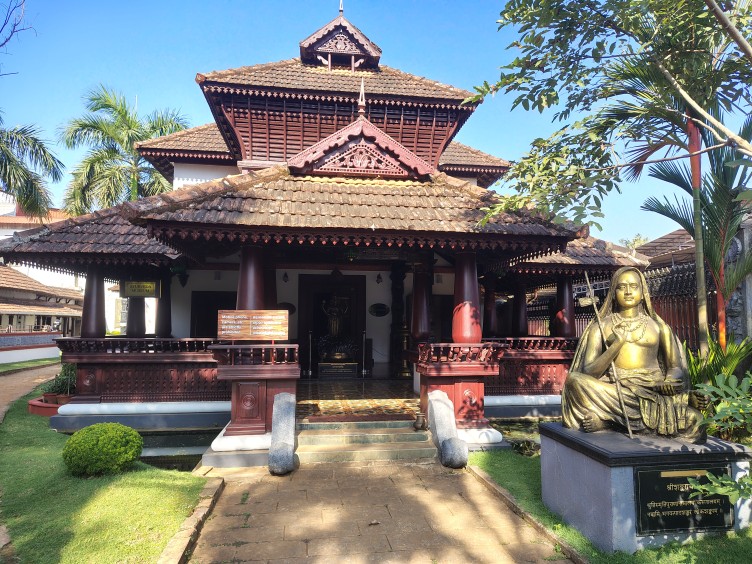
(Vaidyaratnam Ayurveda Museum from outside)
I was particularly struck when Kumar mentioned that the natural human lifespan is believed to be 120 years. However, modern lifestyles have significantly reduced this potential longevity. This, he suggested, is why many people are returning to Ayurveda—an ancient system that relies largely on simple home remedies and upholds the philosophy: “Your kitchen is your pharmacy, your mother is your doctor, your food is your medicine, and your work is your health.” Yet, he also emphasised that Ayurveda is not stagnant; it continues to evolve with changing times.
Overall, my journey to Thrissur was an immersive exploration of its Ayurvedic heritage—a powerful reminder that tradition, when preserved with care, continues to heal and inspire.
Cover Image Credit- Vaidyaratnam Ayurveda Museum